Fifth Universal Definition of Myocardial Infarction (2026)
doi.org/10.1093/eurheartj/ehag101Published simultaneously in JACC, Circulation and Global Heart.
The Heart BriefIssue 1
Redefining the Heart Attack
The world’s most prestigious cardiovascular societies have classified heart attacks into three distinct categories and called for sex-specific diagnostic thresholds.
 By Sarah Miner, CAPIO Research and Public Education
Cardiovascular disease (CVD) is overwhelmingly complex to laypeople and experts alike, so much so that the very definition of a heart attack has undergone five iterations since 2000. Even common conditions remain elusive due to their multidimensional disease pathways as well as the presence of conflicting scientific findings. To the cardiologist, this might be a tantalizing puzzle. To the patient, however, this is stressful and discouraging. A man attempting to prevent a second myocardial infarction (MI, or “heart attack”) might be so confused by contradictory online medical advice that he abandons his venture altogether. Equally, a woman with a genetic predisposition for high cholesterol might not understand the mechanisms by which she is at higher risk for MI, or how to combat it. Clarity is long overdue, particularly for the leading cause of death worldwide.
Fortunately, in August 2026, four of the world’s most prestigious cardiovascular societies, including the American Heart Association and the European Society of Cardiology, collaborated to create the Fifth Universal Definition of Myocardial Infarction, a unified, evidence-based, and comprehensive overview of the spectrum of MI. While this will undoubtedly enhance clinical care, the average patient might not be able to extract meaningful information from the sea of medical jargon. We at CAPIO are dedicated to the translation of medical information into accessible knowledge for the public to fuel greater self-efficacy. In alignment with this goal, we created The Heart Brief, a series which distills one landmark cardiovascular publication at a time. In this inaugural issue, we have simplified the most important takeaways of the new definition below.
Not All Heart Attacks Are the Same
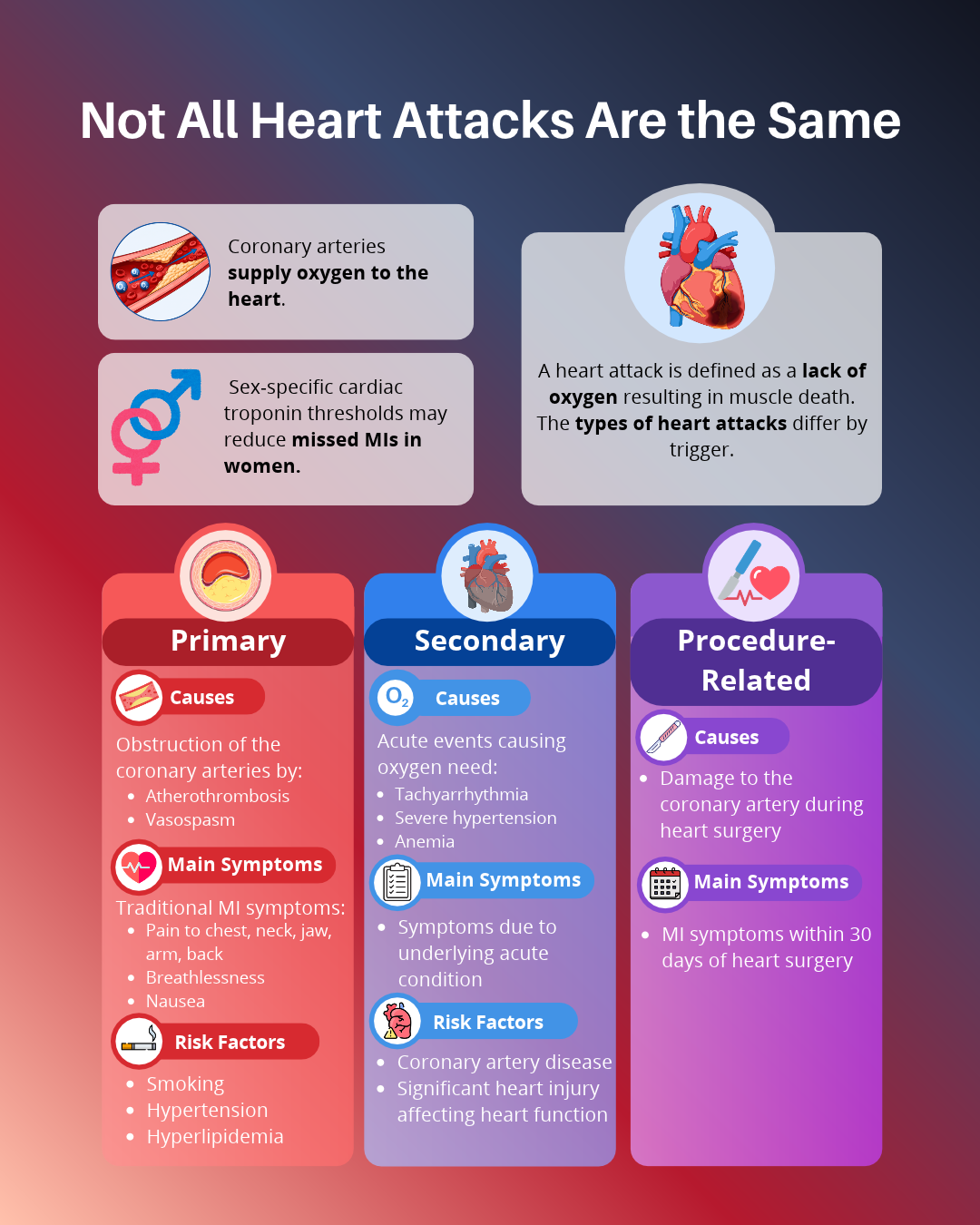
The heart is a muscular pump that needs energy to fuel each beat. Blood vessels (called coronary arteries) encircling the organ form a vast network which continuously supplies this energy in the form of oxygen. Fundamentally, a heart attack is defined as a lack or insufficiency of oxygen resulting in the death of the undersupplied muscle. While all heart attacks share this definition, they may be caused by distinct triggers, each with its own risk factors and presentations. The new definition classifies all MIs into three main categories.
Primary MI is the sudden obstruction of a coronary artery causing heart injury that is not attributable to a cardiac procedure or an alternative acute trigger. This may also be referred to as “spontaneous MI”, or simply “MI”, in clinical settings. Its principal precipitator is coronary artery disease (CAD), which most commonly refers to atherosclerosis (plaque buildup) but also involves other afflictions such as coronary vasospasm (sudden constriction of the artery). Notably, the new definition also encompasses spontaneous coronary artery dissection (SCAD), a tear within the arterial wall which predominantly affects women and remains underdiagnosed. Those at highest risk for atherosclerosis are typically of middle- or old-age, smoke, or have a personal and/or family history of other cardiovascular conditions. The risk profiles of each condition are further described in Table 1. A patient might reasonably suspect a primary MI in the event of traditional symptoms such as chest pain/discomfort, epigastric (upper abdominal) pain and/or pain radiating to the neck, jaw, arm, or back, breathlessness, palpitations, nausea, and/or vomiting. These symptoms should be of particular concern if the patient has known CAD. A clinical diagnosis may be suspected in the face of the appropriate signs, symptoms, and blood levels of troponin (a protein released by injured heart muscle), but can only be confirmed with coronary angiography (X-ray imaging of the coronary arteries), followed by cardiac imaging if angiography is inconclusive.
Secondary MI is the result of an alternative acute condition causing a relative lack of oxygen in the heart without an acute coronary abnormality. This may encompass any sudden condition which increases the heart’s need for oxygen and/or decreases oxygen delivery to the heart, such as tachyarrhythmia (abnormally fast heart rate), severe hypertension (high blood pressure), anemia (low red blood cell count), hypoxia (low bodily oxygen), or hypotension (low blood pressure). Patients with CAD or a heart injury affecting cardiac function are more susceptible to secondary MI, but it is important to stress that these are not its triggers (if they were, a primary MI would be the diagnosis). A patient experiencing a secondary MI may not necessarily endure the traditional symptoms of MI (listed above), and may instead present with the symptoms of the acute precipitating event, such as a severe infection or significant blood loss, making it more challenging to detect. In this sense, a secondary MI may be masked by the very condition that provoked it. The clinical diagnosis of a secondary MI is similarly complicated, as signs, symptoms, and troponin levels are insufficient to prove that the event was of non-coronary origin. Furthermore, many patients may not be candidates for angiography and/or cardiac imaging, as comorbidities such as frailty increase the risks of the procedures.
Procedure-related MI is, by definition, a complication of a cardiac procedure. This encompasses all procedures which risk damage to the coronary arteries, including coronary angiography with or without intervention (e.g. stenting), structural heart interventions, catheter ablation, and open or minimally invasive heart surgery (e.g. coronary artery bypass graft (CABG), valve replacement), and is confined to the 30-day post-procedural period. Baseline risk factors for this type of MI are not well defined, as the event is a direct complication of the procedure itself, with the greatest risk following stenting and CABG. Patients who have undergone a cardiac procedure therefore need not focus on their individual characteristics, and should instead be alerted by a sudden development of traditional MI symptoms following a symptom-free recovery period. A diagnosis may be made through the identification of early restenosis (re-narrowing of a treated artery) or recoil, stent thrombosis (a clot within a stent), or graft failure, or of a new regional wall motion abnormality or loss of viable myocardium on cardiac imaging. Alternatively, a procedure-related MI may present as the persistence of MI symptoms following a cardiac procedure during early recovery. In these circumstances, clinicians may employ electrocardiograms (ECGs) and troponin blood tests to assess the probability of a procedure-related MI, which may guide the need for diagnostic angiograms and cardiac imaging.
Altogether, these categories stress that MI can be triggered under varied conditions in distinct patient populations. Patients must assess their individual vulnerability to each subtype and recognize accompanying symptoms in order to react fast in the event of a cardiac emergency. Regardless of the subtype, anyone who recognizes these warning signs, whether in themselves or in others, should call 911 immediately, as every minute without adequate oxygen results in further loss of heart muscle.
Heart Attacks Are Measured Differently in Men and Women
Abnormally elevated blood levels of cardiac troponin I or T indicate myocardial injury (damage to the heart muscle). Because healthy women tend to have lower baseline troponin levels than men, a single, universal threshold may overlook heart muscle injury in female patients. The authors therefore stress that sex-specific thresholds are necessary to minimize systematic biases which otherwise promote the underdiagnosis of MI in women. Accordingly, they urge clinicians to consider cardiac troponin I or T greater than the sex-specific 99th percentile upper reference limit as the threshold for myocardial injury in patients with suspected MI. In essence, a woman’s heart must be measured against a woman’s threshold.
| Primary | Secondary | Procedure-Related | |
|---|---|---|---|
| General Cause | Acute abnormality (usually obstruction) of a coronary artery | Alternative acute condition causing an oxygen need/delivery imbalance | Complication of a cardiac procedure (within 30 days) |
| Specific Triggers | Atherothrombosis, SCAD, vasospasm, coronary embolism Restenosis, stent thrombosis, or graft failure >30 days after revascularization | Tachyarrhythmia, severe hypertension, hypotension, anemia, hypoxia | Coronary angiography with or without intervention, structural interventions, catheter ablation, heart surgery (e.g. CABG) |
| When To Suspect? | Sudden traditional MI symptoms (e.g. chest pain/discomfort), particularly with known CAD | Sudden symptoms of the acute condition, with or without MI symptoms | New or persistent MI symptoms within 30 days of a procedure |
| Risk Factors | Atherosclerosis (age, smoking, hypertension, high cholesterol, diabetes, inactivity, family history, Black or South Asian ancestry) SCAD (women <50, pregnancy, post-partum) Vasospasm (smoking, East Asian ancestry) | Coronary artery disease, or significant heart injury affecting heart function | Not well defined, but greatest after stenting and CABG |
| Diagnostic Tools | Troponin, then coronary angiography (intravascular imaging or cardiac MRI if inconclusive) | Troponin (insufficient alone), with imaging often deferred until the acute condition is addressed | ECG and troponin to assess probability, then angiography and/or cardiac imaging to confirm |
Source. Mills NL, Newby LK, Zaman S, et al. Fifth Universal Definition of Myocardial Infarction (2026). European Heart Journal. 2026. doi.org/10.1093/eurheartj/ehag101. Published simultaneously in JACC, Circulation and Global Heart.