
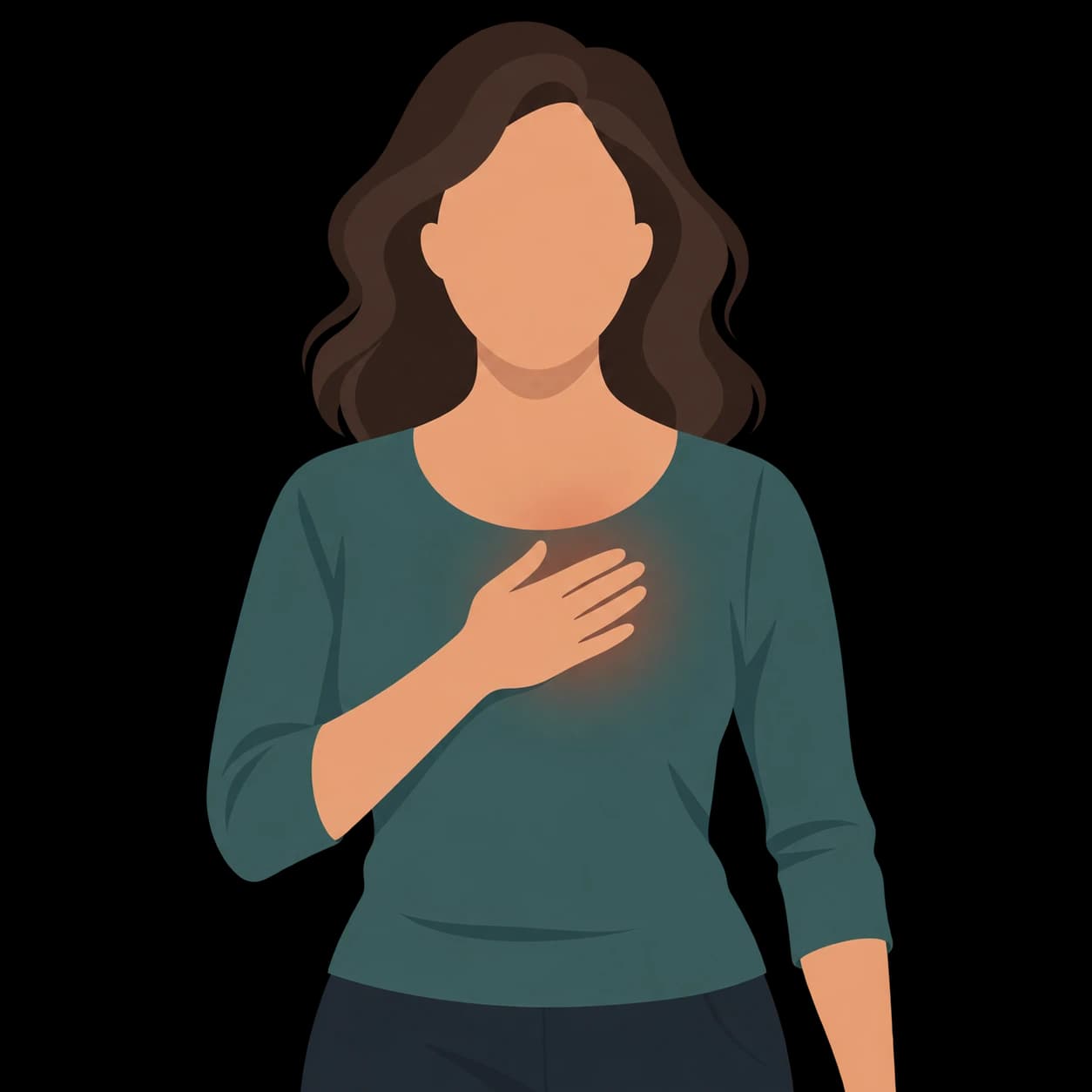
It may not look like the movies
A fist clutched to the chest may be the telltale image we associate with a heart attack, but the real warning signs can be much less obvious. Some people experience several warning signs at once. Others experience only one. Symptoms may be intense, surprisingly subtle or fluctuating. This variability is one reason heart attacks can go unrecognized and delay treatment, which increases mortality from this devastating event in Canada.
Knowing the different ways a heart attack can present helps you recognize when something is wrong and get help sooner.
The most common warning signs
Interactive field notes
The body has more than one way to warn you.

Explore a signal
Symptoms can be mild.
The emergency may not be.
More than “pain”
Pressure, squeezing, tightness, heaviness, fullness, burning or aching. Discomfort may persist, disappear and return, or become more noticeable.
Chest discomfort is the most common warning sign in both women and men.Chest pain or discomfort is the most common warning sign of a heart attack. It is not always a sharp or severe pain. People may describe the sensation as:
- Pressure
- Squeezing
- Tightness
- Heaviness (e.g. as if an elephant were sitting on the chest)
- ‘Fullness’
- Burning
- Aching or discomfort
The discomfort is often felt in the chest. It may persist, disappear and return, or gradually become more noticeable.
Heart attack symptoms can also include:
- Pain or discomfort elsewhere in the upper body, including one or both arms, shoulders, neck, jaw, back or upper abdomen
- Shortness of breath, with or without chest discomfort
- Cold sweats or unexplained sweating
- Nausea or vomiting
- Dizziness or light-headedness
- Unusual weakness or fatigue
- A rapid or irregular heartbeat, or palpitations
Pain can appear outside the chest because the nerves carrying signals from the heart share pathways with nerves from other areas of the body. The brain may therefore interpret pain coming from the heart as coming from the arm, jaw, back or another location. This is known as referred pain.
Importantly, the intensity of the symptoms does not necessarily reflect the severity of the heart attack. Mild symptoms can still signal a serious emergency.
When symptoms don’t look “classic”
Not every heart attack causes dramatic chest pain. Some people experience symptoms that could easily be mistaken for something less serious, such as:
- indigestion or heartburn
- an upset stomach
- unusual tiredness
- shortness of breath
- back, shoulder or jaw discomfort
- weakness
- dizziness
- feeling generally unwell
This can make recognizing a heart attack difficult.
Someone experiencing upper abdominal burning may assume they ate something that disagreed with them. Someone who suddenly becomes exhausted may blame a poor night's sleep. Someone with jaw discomfort may initially suspect a dental problem.
CAPIO aims to shift the question from “Does this look exactly like a heart attack?” to “Could this be a heart attack?” You do not need to be certain before acting: if you suspect a heart attack, call 911.
Heart attacks in women
One common misconception is that women and men experience completely different heart attacks. They do not! Chest pain or discomfort remains the most common heart attack symptom in women as well as men.
However, women more often report additional symptoms alongside chest discomfort, such as:
- shortness of breath
- nausea or vomiting
- upper back, shoulder, neck or jaw discomfort
- unusual fatigue or weakness
- dizziness or light-headedness
- sweating
- indigestion or stomach discomfort
Some women experience these symptoms without prominent chest discomfort, which can make the connection to a heart attack less obvious.
Heart attacks in younger women can also be overlooked because cardiovascular disease is often thought of as a disease of older adults. Yet younger and premenopausal women do have heart attacks, and they are more likely to be diagnosed late and to have worse outcomes as a result. The absence of dramatic chest pain should never provide false reassurance, whether in men or women. Younger women are also more likely to have less common causes of heart attack, including spontaneous coronary artery dissection (SCAD) and heart attacks with no significant blockage in the coronary arteries, known as MINOCA.
Heart attacks in older adults
Heart attacks become more common with age, as cardiovascular risk accumulates over a lifetime, yet they can be harder to recognize in older adults.
Chest discomfort still occurs in many older adults, but some have less prominent chest symptoms and instead experience:
- sudden shortness of breath
- unusual weakness or fatigue
- dizziness or fainting
- nausea or vomiting
- sweating
- a sudden decline in their ability to perform normal activities
Because symptoms such as weakness or shortness of breath can have many causes, they may initially be attributed to aging or to another medical condition the person already has. A new or unexplained change from someone's usual state of health deserves particular attention, especially when several concerning symptoms cluster together.
Heart attacks in people living with diabetes
People living with diabetes have an increased risk of cardiovascular disease. In some cases, diabetes may also make the warning signs of a heart attack less obvious.
Long-standing diabetes can damage nerves throughout the body, a complication known as diabetic neuropathy. When the nerves that carry pain signals from the heart are affected, chest discomfort may be blunted or absent.
A person may instead experience symptoms such as:
- shortness of breath
- unusual sweating
- nausea or vomiting
- fatigue or weakness
- dizziness
- mild chest discomfort
This does not mean that people living with diabetes do not experience chest pain. They often do.
What is a silent heart attack?
The term “silent heart attack” can sound as though absolutely nothing happens. That is not the case. Rather, a silent, or unrecognized, heart attack is one that occurs without the person recognizing their symptoms as a heart attack at the time.
In some cases, there really are few or no noticeable symptoms. In others, symptoms are simply mild or nonspecific enough to be mistaken for something else.
Someone might later recall: “I thought I had indigestion,” “I was unusually tired for a few days,” “I felt strangely short of breath,” or “I thought I had pulled a muscle in my chest or arm.”
Only later might an unrelated medical investigation (such as an ECG or cardiac imaging) reveal evidence of a previous heart attack.
Unrecognized heart attacks are of particular concern in people living with diabetes and those who have previously experienced a heart attack. They matter because heart muscle can still be damaged even when the warning signs were not obvious enough to prompt emergency treatment, raising the risk of heart failure, dangerous heart rhythms and future cardiac events.
For the reasons described above, diabetes can lead to cardiac autonomic neuropathy, a common complication that damages the nerves supplying the heart and is an important contributor to silent heart attacks.
Stable angina or a heart attack?
The two can feel very similar, but the consequences are vastly different, which is why it is crucial to know the difference. Angina is chest discomfort caused when the heart muscle temporarily does not receive enough oxygen-rich blood.
For someone who has already been diagnosed with stable angina, episodes typically follow a recognizable pattern. The discomfort:
- tends to occur with predictable triggers, such as physical exertion or emotional stress
- feels similar from one episode to another
- usually lasts only a few minutes
- improves with rest or prescribed nitroglycerin
In a heart attack, blood flow is reduced enough, and for long enough, that heart muscle gets injured. The problem is that you cannot reliably determine at home whether new chest symptoms represent unstable angina or a heart attack.
Watch for a change in the pattern.
If you have known angina, seek urgent medical attention if your symptoms:
- are new or different
- are becoming more frequent or severe
- happen with less activity than usual or while resting
- last longer than your usual episodes
- If you have any doubt or feel unwell
This may represent unstable angina, which is a medical emergency. If you experience chest discomfort for the first time, do not assume it is stable angina. Call 911!
Module 03 / Knowledge check
Quiz
Adapted from CAPIO’s Module 3 script, with light editing for clarity and linked references. This lesson is educational and does not replace care from a healthcare professional.
Original module script (PDF)